
Carol Spruill Raleigh, North Carolina carol@carolspruill.com
Is This Your Work?

Is your art totally your own creation?
Usually this question would be asked whenever someone copies another painting too closely, especially if doing so without acknowledging the artist who is the source of the inspiration. But the question can also arise in other contexts.
For example, in painting a still life, if I should paint a view of a room, and the part of the room showing was dominated by a painting done by someone else, would I be copying if I duplicated it? My guess is that this depends upon the size of the painting within the painting. Many artists – great and not as great – have included a painting within a painting. It could be a reproduction of their own work hung in their own studio; it could be the work of a friend of the artist that they have bought or borrowed and placed in their own studio; it could be the work of any artist if the painter goes to someone else’s house to paint a still life. But these paintings within a painting are typically quite small. Usually, the strokes just give the impression of the original work, even if quite recognizable. The painting within a painting concept is usually treated with appreciation and sometimes receives a humorous reaction. In short, the concept of a painting within a painting works. On the other hand, if the painting being copied took up half your canvas, people wouldn’t consider it an original work. The painter would just be copying the other artist’s painting.
Some artists also wrestle with the question of when it is okay to paint from a photograph taken by someone else. Some artists go so far as to never use another person’s photograph, and only paint from photos that they themselves have taken. Some think it is okay if only a small portion of the other photographer’s photograph is used. Other artists think it is fair game to paint an entire scene from a photo taken by another photographer. The reasoning for an artist using the photographic work of someone else, and still being original, is that a painting and a photograph are entirely two different art objects. Almost any rendering of the photograph would be an interpretation and not a copy. Yet another line of reasoning that using another’s photograph is okay is to approve of it as long as the artist is merely “inspired” by that work rather than seeking an exact duplication. After all, there are countless variations of how recognizable the original photo might be.
Some painters are “purists” and do not like to use photographs at all – even though they themselves are the photographers. They do not believe a two-dimensional source is real enough. Instead, these painters make sure that the entire piece of art is of their direct creation. They may arrange the still life, or go outside and paint a landscape in plein air, or pull images or abstractions out of their head. They will not even “copy” themselves!
Let us say that you are an artist who chooses to paint still life from objects you arrange. Yes, even then, the artist may be in danger of copying. Can you say that this is totally your work? This gets really picky, but which objects of your painting inspiration are fair game? Let’s imagine that you choose to use a sculpture as your center of attention in your painting, but the sculpture is the work of a great sculptor with a well-known style. Your painting renders an image of the sculptor’s creation squarely in the center of your canvas. In such a case, is this your art, or is it the art of the sculptor who originally made the form you copy? What about other objects about your house? What about artistically rendered pots, or furniture or rugs or tapestries? Matisse, Picasso and other masters, for example, became huge fans of African masks. The makers of most of these masks were never known outside their communities, and may have been part of a collective community effort. Or the artist making the mask may have been known in some time and place, but now his or her name is lost to history. When these masks – like many other art forms introduced to European artists from around the world – became known to European artists, the European artists were fascinated. The masks, and urns, and harem chairs and Moroccan tapestries, started showing up in their paintings. The painters received much acclaim for their “originality.” But who was the originator - the mask maker, the tapestry designer or weaver, or the person who designed and produced an intricate Turkish tile? Why is the person heralded for this beautiful work the one who reproduces these creations in paint?
Then, finally, there is the issue of “cultural appropriation.” Is this your work, or the work of a people to whom you do not belong? Is each artist confined to his or her background, or can the artist venture out to experiment with new styles to which they become exposed? For example, I once spent hours in a museum fascinated by my first close encounter with Aboriginal art. How different the form was to me. How exciting! What a unique interpretation! The uniqueness of the style was shared by “Aboriginals” in the Australian continent, and many different Aboriginal artists created unique pieces that were recognizable as a style of a continent of people. While these artists are working in this general and recognizable community style, the products of their artistic ability evidence an endless variety and the specific style of most of these artists is their own. The art is both the product of community work while at the same time being each a unique original work. Today this art form remains a practice and is available for sale, produced by many exciting, contemporary Aboriginal artists. But is it okay for non-Aboriginal artists to use the style?
Am I – a person who has never even been to Australia – free to experiment with an Aboriginal style? I have tried this quite a few times. In my defense, if I need one, I tried to give my “Aboriginal”paintings a look that could not be confused with any I had seen. One way I did this was by “fusion” with a “Western” style. One of mine, for example, was called “Aboriginal Meets Pop.” It had the marks of the aboriginal style, mainly dots forming patterns throughout the piece, but the background was in intense colors, like fuschia, that would not be confused with a typical Aboriginal style.
I hope my experimentation with the Aboriginal style is culturally acceptable. However, I cannot help but dwell on whether my work is sufficiently original whenever I use part of another person’s photograph, paint an inside-the-picture painting done by another artist, paint a ceramic or sculpture or other piece of art by someone else within my painting, or borrow the style of other cultures. What do you think? Whose art is this? Is this your work?
Consistency versus Originality

"Into the Night" 12 x 16 Acrylic on Canvas (2018)
Often art enthusiasts advise new artists to be consistent in their work. Gallery owners, it is said, are at the head of this line. After all, the gallery owners spend money and energy helping to create the image and reputation of an artist. As a result, over time and if successful, collectors will be interested in the work of that particular artist and the artist will profit from a growing audience eager to buy their work. If the artist is too varied in his or her artistic expression, the collectors may be confused about what they are getting when they “invest” in that artist. A successful artist, then, must not only have a good product but also art that someone can look at and identify.
As an artist and an enthusiast, I get it. I know the thrill that one gets from building up their body of art knowledge to the point that they can look across the room in a museum and say, yes, that is a Picasso, and that is a Monet, and that is a Georgia O’Keefe, and later – once knowledge of more great historical and contemporary artists is acquired – that is a Marsden Hartley and that is a Stuart Davis, and that is a Kehinde Wiley (now becoming widely known as the artist who did Obama’s official portrait). Some collectors and art lovers appreciate the art of their state or region and learn the “canon” of artists at the state level and the local level. They too get a thrill from being able to tell which painting is the work of a particular local artist. The art enthusiast is rewarded for her studious observation, if only to smile inwardly and say to herself, “I know who did that.”
But what about originality? An artist does not want to spend a career producing work like a machine – all precision with one piece just like the other. Those who have an artistic temperament are well known for “wanting to color outside the lines,” and do not want to be dictated to or to endure narrow confinements being imposed on their creativity.
Similarly, a collector values originality. She does not put the same value on a piece of art that looks exactly like the one in her neighbor’s living room. She wants something new, exciting, and DIFFERENT! After all, the collector is attracted to artists largely due to their creativity, so too much consistency gets boring.
This paradox means that an artist has a sweet spot to aim for. Her work must be original, yet identifiable, at the same time. How can this be accomplished?
The great masters have exhibited both originality and consistency. We know them both because they presented something identifiable, but at the same time excited their patrons with the new. They surely value their originality, but, at least for the last hundred or so years, artists have felt free to be consistent even to the point of creating not just one, but a whole series of the same subject matter. Many examples come to mind. Monet had his haystacks and his Rouen Cathedrals, and, for goodness sakes, hundreds of paintings of his lily pond produced over a twenty-year period. He and other artists frequently chose the same subject, but made it a different painting by having it depict different moods and angles and times of day. Other artists work months or years on a style and then take a turn to another style. Picasso had his Blue Period, his Rose Period and his Cubism Period, plus many others throughout his long life. Matisse did his odalisque paintings and his African masks; he went through his Fauvism period and his work that resembled Pointillism and the style of Cezanne. And so on.
The emerging artist may have a hard time figuring our which style to adopt, and might resist a career of getting known for one thing and being stuck with it. How does she negotiate her desire for identity while maintaining experimentation? She might, like the great artists mentioned above, use the approach of creating a series of similar paintings in order to identify a style – developing one idea, and then moving on at some point to another style. But artists are advised not to put too many different ideas out at once, and especially not into the same exhibition. The buyer, it is said, will be confused by this approach.
It does take awhile for an artist to “find herself” and identify what she is most passionate about – what medium, what subject matter, what style. Abstract or realism or somewhere in between. Landscapes or still life or portraits of people or pets. Oils or acrylic, or cold wax, or encaustic or collage, or pastels. Brushes or palette knives or stencils or dead sharks. (See Damien Hirst.) So many choices! If this sounds like a confession, it is! All except for the encaustic (not yet) or the dead sharks (never). However, if artists are lucky, they might be able to keep making art across these categories with a certain style that allows the viewer to see the references from one of the artist’s pieces of art to another, even those in a different category.
It is this ability to find a style, eventually cultivated by mature artists, that allows them to keep experimenting throughout their careers yet still be recognized for their “consistent” body of work. Matisse’s paintings move from mostly oils to pin-up collage in the end; but throughout, he was still celebrated for being the unique and masterful and recognizable artist that he was. Picasso moved all around from painting to drawing to ceramics to sculpture to prints to tapestries to rugs to creating art with bits of scraps. All of it looked like Picasso.
So grant the emerging artist time to develop. Recognize the desire to create, the desire to be original, and the desire to perfect craft and attempt to evolve through experimentation. In the end, we, the viewers, are rewarded when new artists add originality in creating and expanding the canon of art, and, in the end, we the viewers receive much more than a cookie cutter cliché.
All the Art We Cannot See

"Irish Greenhouse," 12 x 16, Oil on canvas (2016)
When I started getting serious about painting again a few years ago, I read a lot to acquaint myself not just with painting techniques, but the art industry in general. One subset of this interest was a macabre fascination with art theft.
I learned that the myth of the rich man sitting in a secret den with his stolen masterpiece behind a velvet curtain for only him to view was untrue. The true world of art theft was much different. Typically, people stealing art are not art lovers, or even knowledgeable about art. They usually cannot sell any masterpieces they successfully get away with because the artwork is too well known and the provenance would be checked by any dealers. So where is the art? The stolen art is sometimes passed among criminal gangs and is used as a bargaining chip to reduce criminal sentences when thieves are caught. Stolen art may sit for years in close-knit communities in far flung corners of the world where it would be impossible for an art theft investigator to show up unnoticed to try to locate the art. I read that many museums are sitting ducks. They can neither afford adequate insurance for the priceless items they possess, nor can they afford to hire enough guards. If a theft occurs, the public does not always know it. Embarrassed institutions may just negotiate a ransom and quietly get the piece back. After all, if other potential donors do not think art they contributed would be protected, they might not choose to donate art to that museum.
Fortunately, a few books and Netflix documentaries later, I got over my fascination with this topic and moved on. But, in addition to grieving over masterpieces that we cannot see anymore due to art theft – for instance Rembrandt’s only seascape ever painted, The Storm on the Sea of Galilee – that was part of the 1990 heist from the Isabelle Stewart Gardner museum – I started contemplating all the other reasons that we do not see art.
Here is my list:
- We do not see art because our most famous museums have far more art than they have space to exhibit. Some pieces sit forever in dark storage rooms in their basements.
- We do not see art because there is a thriving investment business in buying high-end art. Masterworks may be purchased not because the buyer loves the piece, but because it is more precious than diamonds, gold or, pound for pound, almost any other commodity. This type of buyer purchases art because it is a hedge against inflation, and thus a very safe investment. Huge secure units exist in “safe harbors” around the world, such as in Switzerland, where art is stored year after year in climate-controlled containers with no one to view it.
- We do not routinely see even that art which hangs on museum walls if it is not in the city where we live. The most fortunate of us travel widely, but no one can get to all the museums around the world. Even someone who could get to them all would get to them all only a limited number of times.
- We, of course, do not see all the art purchased by private buyers who display it in their homes, unless we are lucky enough to be guests there, and only as long as we are guests.
- Even the artists who create their own work may see it only briefly. Off it goes to the new owner. Once Vincent mailed his work off to Theo, it was not around for Vincent to see again. Matisse did travel with great fanfare from France to the art-filled apartment of the Cone sisters in Baltimore to gaze on his art once more, then back to France he went. Vermeer’s work went out the door quickly to pay for his family expenses and art supplies. Happily, I recently learned that he did keep his favorite piece all his life – both for his enjoyment and also to show potential customers what he could do. It was called The Allegory of Painting, aka The Art of Painting, and it was one of his largest (I saw this beautiful work last summer in the Kunsthistoriches Museum in Vienna). Alas, his widow lost it through bankruptcy after his death after trying in vain to keep it from bankruptcy by giving it to her mother.
The odd part, then, about our fascination with the disappearance of art through theft, is that we, the art-loving public, grieve immensely over the piece of stolen art, as well we should. But hardly ever does anyone talk about the shame of not being able to see the vast majority of the art we do not see.
While it will never make up for the art that we cannot see, stolen or otherwise, at least we now have photography and other ways of making reproductions. Artists can photograph and create an archive of their work to have around the studio. We can leave the art museum with the images on our cameras, or on gift shop postcards, or even on scarves and other products. And anyone with access to the internet can now explore the treasures of the world with hundreds of thousands of images of art from museums everywhere. If we are willing to look at the images, there is hardly any art that we now cannot see.
Blogs & Essays - I Have Something to Say!
Dear Art Lovers,
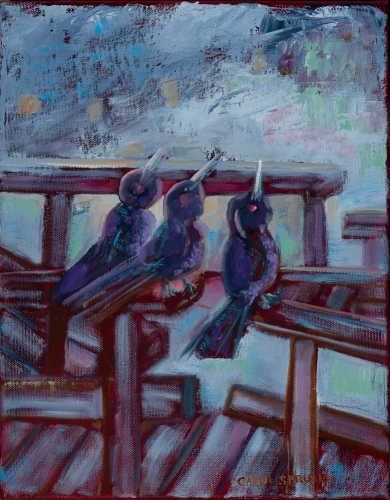
I not only love to create art. I also like to read, write and think about art. So I will be sharing my thoughts periodically about art, the producing of art, the history of art, and the philosophy of art, whenever I have something to say.
My first blog is called "All the Art We Cannot See" that I posted before my web launch. I will follow that with a posting about once per month. Once this website is published, the blog titles for blogs 2 through 6 after "All the Art We Cannot See" are:
- Consistency versus Originality
- Is This Your Work?
- The Various Reasons to Make Art
- I Grow Older and Bolder
- What Does It Mean for an Artist to Paint from her Psyche?
I hope you enjoy!
Carol